In today’s fast-changing world, leaders need more than just internal data to make sound decisions. Understanding the external environment is critical — and that’s where PESTEL Analysis becomes an essential tool.
Whether you’re launching a product, entering a new market, or navigating digital transformation, PESTEL helps you see the bigger picture.
🔍 What is PESTEL Analysis?
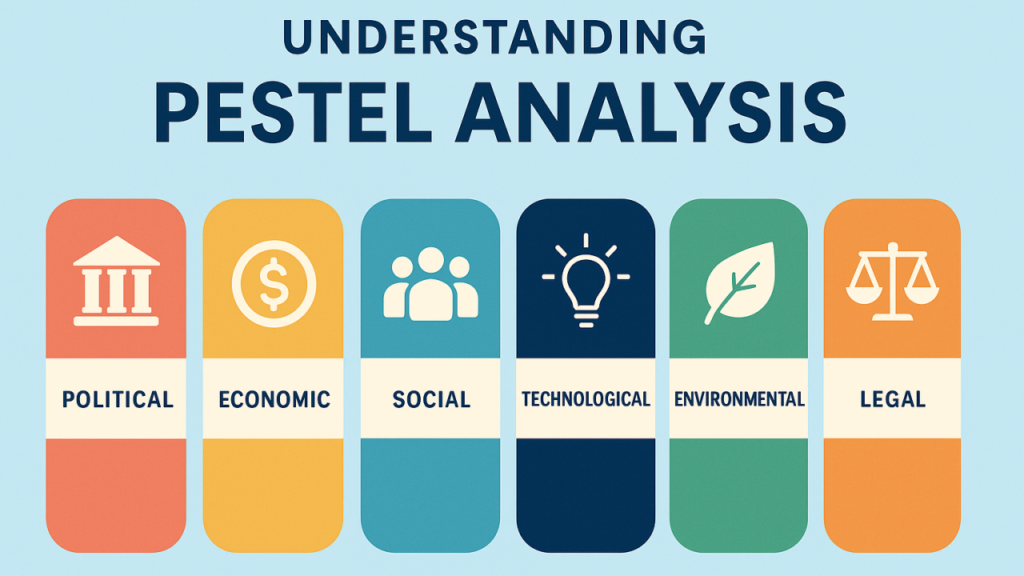
PESTEL stands for Political, Economic, Social, Technological, Environmental, and Legal factors — a structured framework that helps organizations analyze and monitor macro-environmental influences that could impact performance or decision-making.
It’s used across industries by executives, consultants, marketers, and strategists to:
- Spot opportunities & threats
- Reduce risk in planning
- Align strategic decisions with external trends
🧭 The Six Pillars of PESTEL (Explained with Examples)
Let’s break down the six dimensions and what you should look for in each:
1. 🏛️ Political
Covers government policies, political stability, tax regimes, and trade restrictions.
Example: A company expanding into the Middle East must assess government incentives, data residency laws, and import regulations.
2. 💰 Economic
Includes economic growth, inflation, interest rates, exchange rates, and employment levels.
Example: A SaaS business might reconsider pricing models in markets facing high inflation or currency devaluation.
3. 🧑🤝🧑 Social
Analyzes demographics, cultural trends, education levels, lifestyle changes, and population growth.
Example: Fintech startups targeting Gen Z should consider rising demand for ethical investing and digital banking habits.
4. 💻 Technological
Looks at innovation, automation, R&D activity, and emerging tech disruptions.
Example: Retail businesses embracing AI for inventory management must assess tech maturity and adoption rates in different regions.
5. 🌱 Environmental
Focuses on sustainability, climate change, carbon emissions, and eco-regulations.
Example: A logistics firm operating in Europe must account for strict emissions policies and rising carbon taxes.
6. ⚖️ Legal
Covers employment law, IP regulations, health & safety, consumer protection, and antitrust laws.
Example: E-commerce companies must navigate GDPR in the EU or CCPA in California when handling customer data.
🧠 Why Use PESTEL Analysis?
Because ignoring external forces can be costly.
🔸 A promising product may fail due to an overlooked regulation.
🔸 An investment may underperform because of political instability.
🔸 A campaign might backfire due to cultural insensitivity.
PESTEL helps you look outside-in, asking the tough questions before the market does.
📌 When to Use PESTEL?
- Launching a new product or service
- Expanding into new geographies
- Building a strategic plan
- Conducting SWOT analysis (PESTEL informs the “Opportunities” and “Threats”)
- Entering an M&A or partnership discussion
✅ Tips for Applying PESTEL Effectively
- Customize by industry: A tech firm’s priorities will differ from a manufacturing company.
- Update regularly: The macro environment evolves fast — PESTEL isn’t a one-time exercise.
- Use data & reports: Reference trusted sources (World Bank, IMF, Gartner, etc.) for credibility.
- Layer with other tools: Combine with SWOT, Porter’s 5 Forces, or scenario planning.
🎯 Final Thought
PESTEL isn’t just an academic framework. It’s a practical, powerful tool that helps businesses stay ahead of change, mitigate risk, and seize strategic opportunities.
In a world shaped by global forces — from AI and climate change to geopolitics and regulations — PESTEL equips you with foresight, not just hindsight.
Leave a Reply