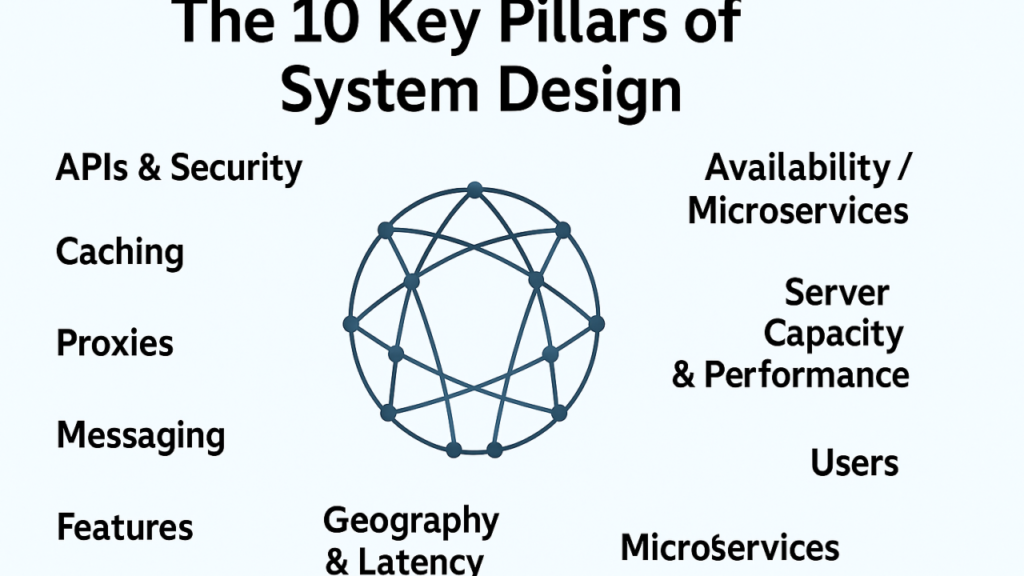
Building modern distributed systems isn’t just about writing code—it’s about making decisions across architecture, scalability, performance, and trade-offs. Whether you’re preparing for a system design interview or building production-grade platforms, these 10 key pillars will guide your thinking.
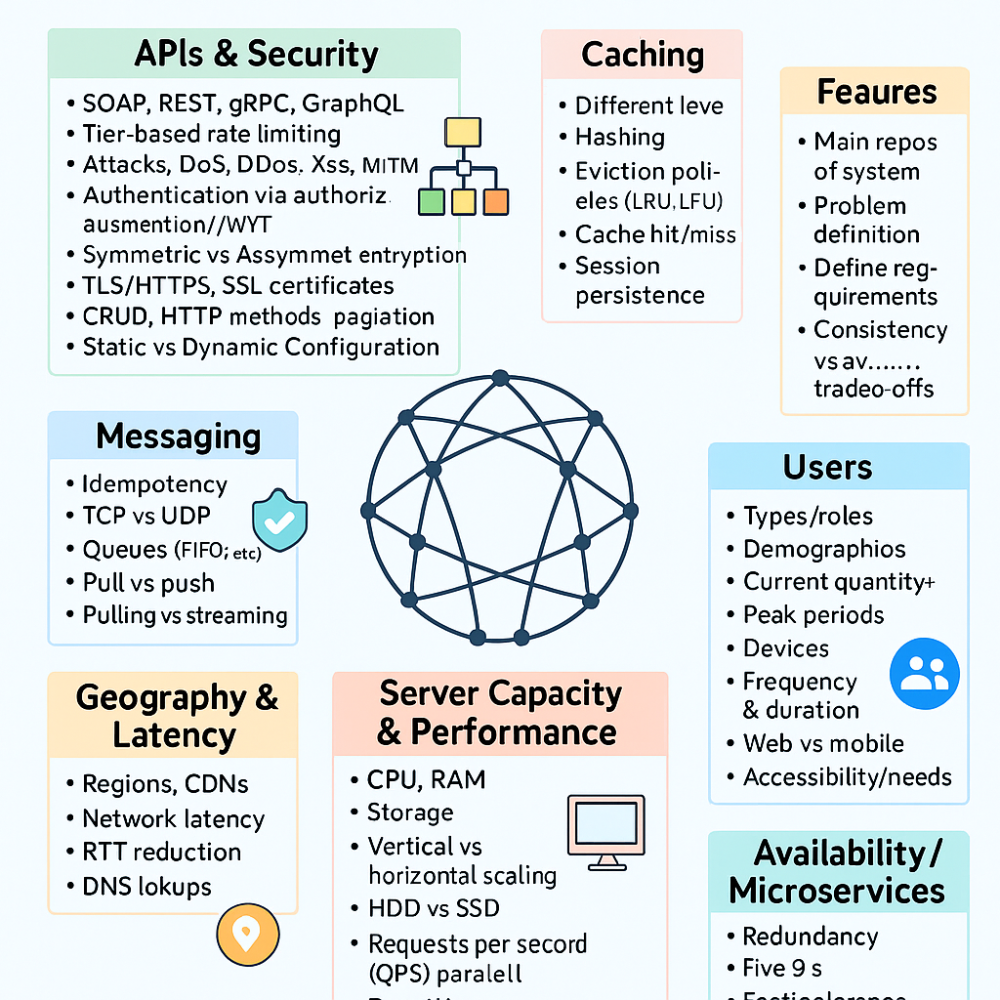
Let’s go deep 👇
💡 1. APIs & Security
APIs are the contracts of your architecture. Designing them securely and efficiently is non-negotiable.
- Protocols: REST, SOAP, GraphQL, gRPC—each with different semantics.
- Rate Limiting: Prevent abuse via token buckets or leaky buckets (tier-based).
- AuthN vs AuthZ: Use OAuth2/JWT for identity, RBAC/ABAC for access control.
- Encryption: TLS for transport; symmetric/asymmetric encryption for data at rest.
- Defenses: XSS, CSRF, SQLi, DoS/DDoS—harden endpoints, validate inputs.
- Static vs Dynamic Config: Secure your secrets and use feature flags wisely.
⚡ 2. Caching
A well-placed cache can save milliseconds or even entire workloads.
- Multi-level (L1, L2, CDN edge)
- Hashing algorithms (consistent hashing for distributed cache)
- Eviction policies: LRU, LFU, FIFO depending on access patterns
- Cache invalidation: One of the two hard things in CS 😉
- Session persistence: Think sticky sessions for stateful apps
🛰️ 3. Proxies
Your silent gatekeepers for performance, security, and routing logic.
- Reverse Proxy: Terminates TLS, handles SSL offloading, load balancing
- Forward Proxy: Filters outbound traffic, adds anonymity (e.g., VPNs)
- Load Balancing: Round-robin, least connections, IP-hash, path-based (L7)
- Service Discovery Integration: Especially important in dynamic environments (e.g., Kubernetes)
📬 4. Messaging
If your services need to scale independently, you must embrace async.
- Message queues (RabbitMQ, Kafka, SQS) decouple producers from consumers
- Pull vs Push: Use pull for control, push for speed
- Streaming vs Polling: Kafka vs traditional queues
- Idempotency: Retries are common—avoid duplicate effects
- FIFO vs exactly-once vs at-least-once—each has costs
🛠️ 5. Features
Start with clear functional requirements.
- What problem are you solving?
- MVP scope: Prioritize features that de-risk your architecture
- Drive design decisions: Are you building for consistency or speed?
- Be ready to explain trade-offs: Eventual consistency, CAP theorem, etc.
👥 6. Users
Design is only as good as your understanding of the end-user.
- Usage patterns: Daily peaks, batch jobs, concurrent users
- Web vs mobile latency tolerances
- Accessibility: Keyboard navigation, color contrast, screen readers
- Demographics & growth: Will your design scale across regions and cultures?
🧮 7. Data Model
How you model data defines your system’s flexibility and performance.
- Relational: ACID, normalization, joins—great for consistency
- NoSQL: Key-value (Redis), Document (MongoDB), Graph (Neo4j), Time-series (InfluxDB)
- Sharding: Choose shard keys wisely; avoid hotspots
- Replication: Write master/read replicas, eventual consistency models
- ETL/ELT pipelines: For analytics, data lakes, warehousing
🌍 8. Geography & Latency
Latency is the killer of UX. Design for distance.
- CDNs for static assets
- Global data centers with failover
- DNS lookups + resolution time
- Network hops and RTT optimization
- Edge computing for ultra-low-latency services
🖥️ 9. Server Capacity & Performance
Understand how your infrastructure responds under load.
- CPU-bound vs IO-bound workloads
- Threads, goroutines, async models
- SSD vs HDD: IOPS differences matter
- Parallelization: Horizontally scale when vertical scaling ends
- QPS and throughput: Monitor, test, and tune regularly
⚙️ 10. Availability & Microservices
Design for failure. Assume everything will break.
- Redundancy: Multi-zone/multi-region setups
- Circuit Breakers: Prevent cascading failures (Netflix’s Hystrix model)
- Retry logic with exponential backoff
- Sidecars & Service Mesh: Traffic control, telemetry, and security (Istio, Linkerd)
- Observability: Logs, metrics, tracing (ELK, Prometheus, OpenTelemetry)
📌 Final Thought:
System design isn’t about knowing everything—it’s about asking the right questions and navigating trade-offs. This checklist is your compass 🧭.
Which of these pillars are you focusing on in your current system? Let’s discuss 👇
#SystemDesign #Architecture #Scalability #DevOps #BackendEngineering #DistributedSystems #TechnicalLeadership #DesignPatterns
Leave a Reply