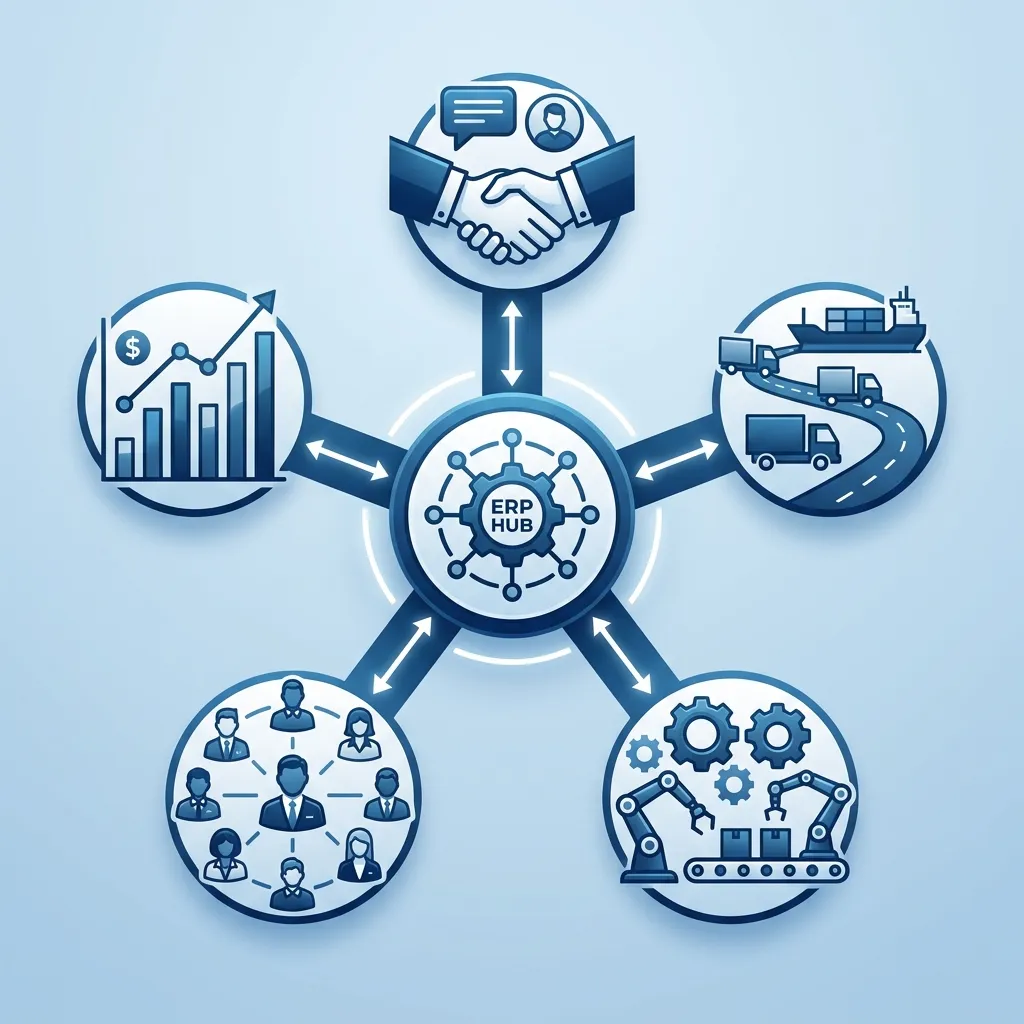
ERP isn’t just software — it’s the central nervous system of modern business. Yet too many professionals interact with ERP systems every day without stepping back to see the full picture. This blog is my attempt to demystify the landscape I’ve been navigating for years.
Let’s break it down: What is ERP, who builds it, which industries depend on it, and what are the core pillars that make it all work.
🧩 What Is ERP — Really?
Enterprise Resource Planning is a unified software platform that integrates all core business processes into a single system with a single source of truth. Finance, HR, supply chain, manufacturing, CRM, procurement — all connected in real time.
Think about the alternative. Finance working in QuickBooks. HR managing payroll in spreadsheets. Supply chain running on yet another tool. And none of them talk to each other. That’s not efficiency — that’s chaos.
ERP replaces that chaos with order. One database. One version of the truth. Every department working from the same playbook.
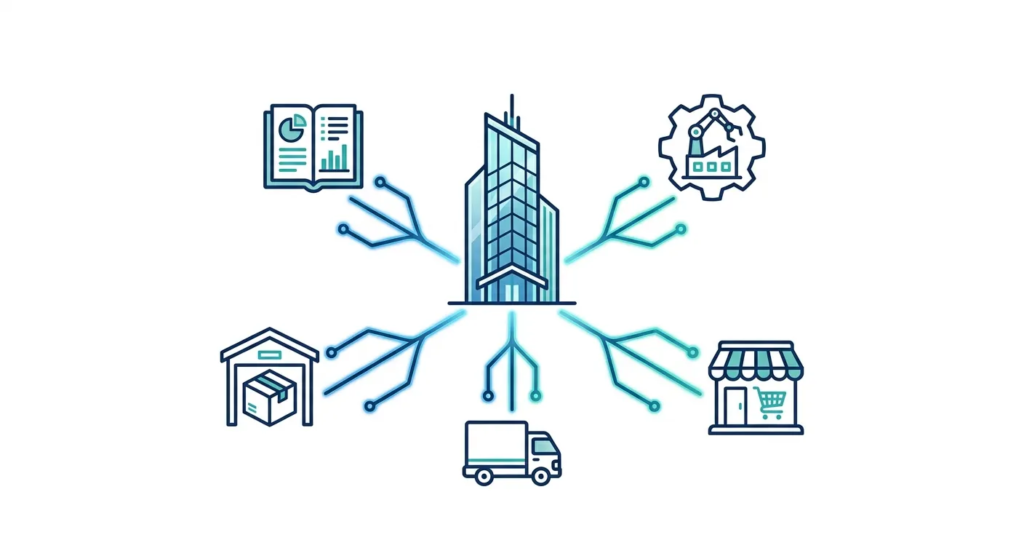
By the numbers: The global ERP market hit $147 billion in 2025 and continues growing. Over 1.4 million companies worldwide run on ERP systems, and 70% of all deployments are now cloud-based.
🏢 The Key Players: Who Builds ERP?
The ERP market is dominated by a handful of giants — but the landscape is shifting faster than most realize.
The Big Three
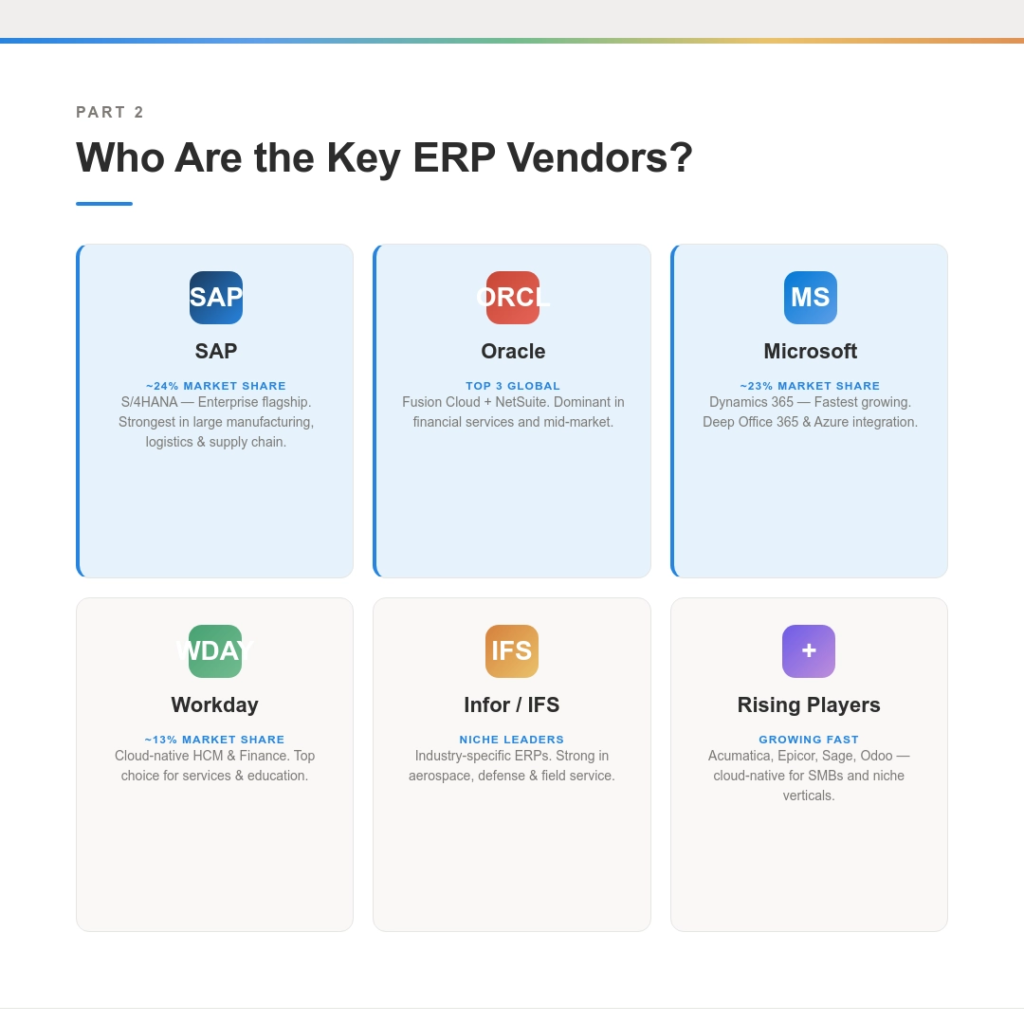
SAP (~24% market share) is the undisputed heavyweight in large enterprises. Their flagship S/4HANA platform is the gold standard for manufacturing, logistics, and complex supply chain operations. If you’re running a global factory network or a multi-national supply chain, SAP is almost certainly in the conversation.
Oracle has evolved from a database company into a full-stack ERP powerhouse. Fusion Cloud serves large enterprises while NetSuite dominates the mid-market — particularly strong in financial services, software companies, and international subsidiaries of global groups.
Microsoft Dynamics 365 is the fastest-growing ERP platform in 2026, with 25-30% annual growth driven by Dynamics NAV migrations and deep integration with Office 365 and Azure. For organizations already in the Microsoft ecosystem, it’s the natural choice.
The Specialists
Workday (~13% market share) — Cloud-native from day one. The leader in HCM and Finance for services, education, and healthcare. If your business is people-first, Workday is hard to beat.
Infor & IFS — The industry-specific specialists. Aerospace and defense. Field service management. Complex asset-intensive industries. These aren’t general-purpose ERPs — they’re purpose-built for verticals where generic solutions fail.
Rising Stars — Acumatica, Epicor, Sage, and Odoo are reshaping the SMB market with cloud-native, consumption-based pricing and flexible architectures. For companies under 500 employees, these platforms offer 80% of the capability at a fraction of the complexity.
🏭 Industries That Live and Breathe ERP
Every industry runs on ERP — but each extracts fundamentally different value from it.
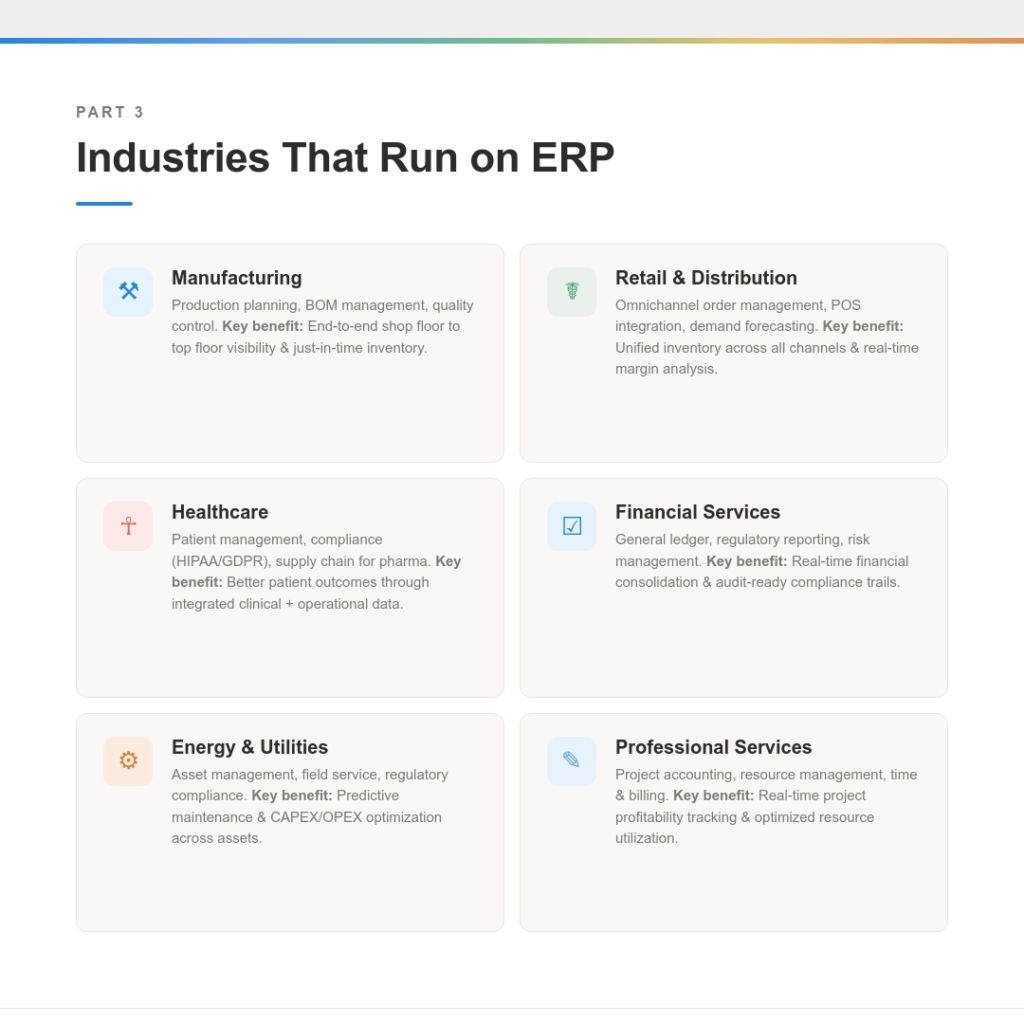
Manufacturing
The challenge: Complex BOMs, multi-level production planning, quality management, and just-in-time inventory across global facilities.
What ERP delivers: End-to-end shop floor to top floor visibility. A production order in one plant triggers procurement, schedules machine time, allocates labor, and updates the P&L — automatically. Manufacturers using integrated ERP report 20-30% reduction in inventory carrying costs and significantly fewer production delays.
Retail & Distribution
The challenge: Omnichannel complexity — inventory split across warehouses, stores, and e-commerce, with real-time margin pressure.
What ERP delivers: A single view of inventory across every channel. When a customer buys online, the system instantly updates warehouse stock, triggers replenishment if needed, and recalculates margins in real time. No more overselling. No more manual reconciliation.
Healthcare
The challenge: Clinical data in one system, operational data in another, financial data in a third — and patient outcomes suffering in between.
What ERP delivers: Integrated clinical, administrative, and financial workflows. Patient flow analysis identifies bottlenecks. Supply chain ensures pharmaceuticals and equipment are available when needed. Compliance (HIPAA, GDPR) is built into the transaction trail. The result: better patient outcomes through operational excellence.
Financial Services
The challenge: Real-time consolidation across entities, regulatory reporting across jurisdictions, and audit-ready compliance at all times.
What ERP delivers: A single general ledger with automated inter-company eliminations. Regulatory reports generated at the push of a button. Every transaction — from journal entry to payment — is traceable, auditable, and compliant.
Energy & Utilities
The challenge: Massive asset fleets (rigs, pipelines, grids) requiring predictive maintenance, regulatory compliance, and CAPEX/OPEX optimization.
What ERP delivers: Asset lifecycle management from procurement to decommissioning. Predictive maintenance algorithms that flag equipment before it fails — saving millions in unplanned downtime. Integrated project controls for capital projects.
Professional Services
The challenge: Project profitability is everything — but tracking time, expenses, resources, and billing across dozens of concurrent projects is a nightmare.
What ERP delivers: Real-time project accounting. Resource utilization dashboards. Automated billing based on project milestones. Services firms using ERP report 15-25% improvement in project margins through better resource allocation alone.
🏗️ The 6 Pillars of Every ERP System
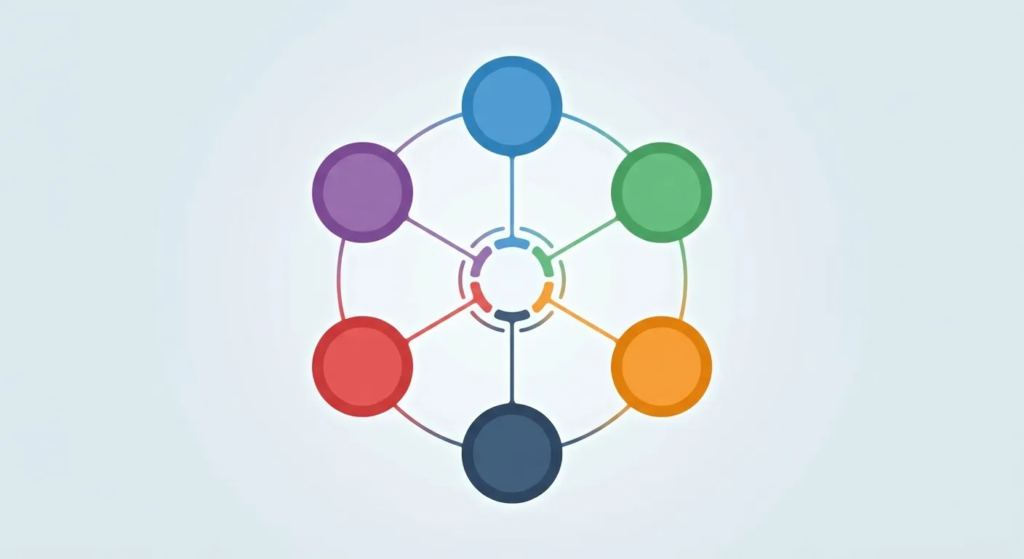
Regardless of industry or vendor, every modern ERP is built on these six foundational modules. Think of them as the organs of the business body — each has a distinct function, but none works in isolation.
1. Finance & Accounting
General ledger, accounts payable/receivable, fixed assets, financial consolidation, and multi-currency reporting. This is the heartbeat of the ERP — every transaction from every other module eventually hits the books here.
2. Human Capital Management (HCM)
Payroll, recruiting, onboarding, performance management, and workforce planning. In services-heavy industries, HCM is often the most critical module — because people are the product.
3. Supply Chain Management (SCM)
Procurement, inventory management, warehousing, logistics, and order management. SCM is where ERP directly impacts the bottom line — a 5% improvement in procurement efficiency can translate to millions in savings for mid-size manufacturers.
4. Manufacturing Operations
Material Requirements Planning (MRP), Bill of Materials (BOM), production scheduling, quality management, and Manufacturing Execution Systems (MES). This is where plan meets production — and where ERP earns its keep in industrial companies.
5. CRM & Sales
Lead-to-cash process, pipeline management, quoting, service operations, and field service management. When CRM is part of the ERP (rather than a separate system), the handoff from sales to fulfillment is seamless — no more “the sales team promised something operations can’t deliver.”
6. Business Intelligence & Analytics
Real-time dashboards, operational reporting, forecasting, and increasingly — AI-driven insights. BI is no longer a separate add-on. It’s embedded in every modern ERP, turning raw data into decisions at the speed of business.
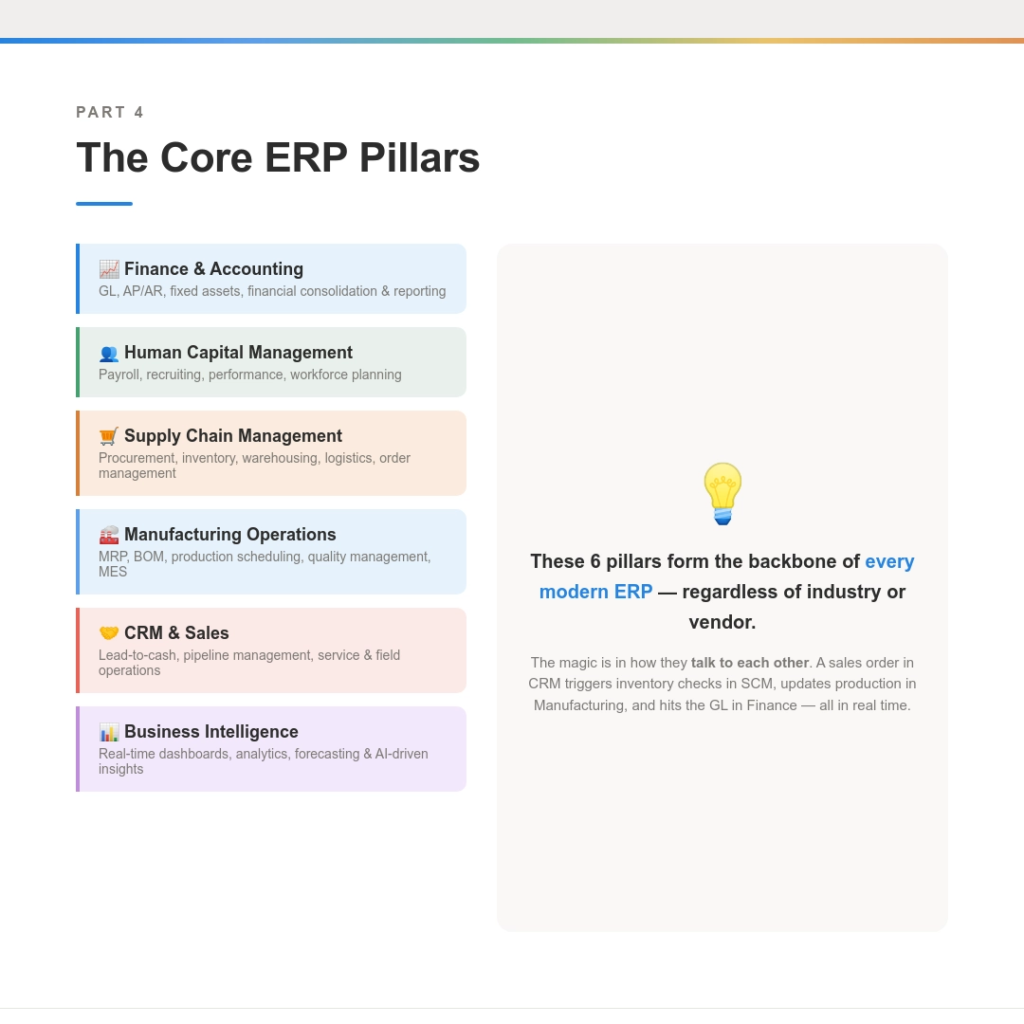
The real magic? These six pillars talk to each other. A sales order in CRM triggers inventory allocation in SCM, which generates a production order in Manufacturing, which updates the GL in Finance — all in real time, without a single spreadsheet or email. That’s what “integrated” actually means.
🎯 The Bottom Line
ERP is the operating system of your business. Pick the right one — for your industry, your scale, and your future — and it transforms fragmented operations into a competitive advantage. Pick the wrong one, and you’ll spend years and millions trying to make it fit.
The market is evolving fast. Cloud adoption has crossed the 70% threshold. AI capabilities are now a top-3 selection criterion for 65% of organizations. And the line between ERP, CRM, HCM, and BI is blurring into a single, intelligent platform.
Leave a Reply